
Where threats meet intelligence
Experienced vCISO Capabilities, Secure System Design, Cyber Threat Assessments, Penetration Testing and Open-Source Intelligence (OSINT)
"Security comes from understanding the business, its culture, and its technology. Only when you understand all three can you have the greatest level of success defending against threats by modern adversaries."
Select a service option below to learn more:
Threalligence, LLC - All Rights Reserved 2026

Is a vCISO right for your organization?
A Virtual Chief Information Security Officer (vCISO) is an cybersecurity expert who provides strategic security leadership to organizations without the need for a full-time, in-house CISO. vCISOs bring extensive experience in risk management, compliance, and cybersecurity strategy, helping businesses strengthen their security posture in a cost-effective manner.Threalligence delivers experienced, certified, and highly professional cybersecurity services designed to help organizations protect their critical assets and operate with confidence in an evolving threat landscape. Backed by industry-recognized certifications and real-world expertise, Threalligence provides strategic guidance, risk assessments, compliance support, and proactive security solutions tailored to each client’s unique environment. By combining deep technical knowledge with a business-focused approach, Threalligence ensures that security initiatives align with organizational goals while meeting regulatory requirements and industry best practices. Clients benefit from a trusted partner committed to delivering reliable, scalable, and results-driven cybersecurity services with the highest standards of professionalism and integrity.
Job Roles & Functions of a vCISO:
Cybersecurity Strategy Development: Creates and implements security frameworks tailored to the organization’s needs.
Risk Management & Compliance: Identifies risks, ensures regulatory compliance (e.g., HIPAA, GDPR, CMMC, NIST), and mitigates vulnerabilities.
Incident Response & Threat Management: Develops and oversees incident response plans to quickly detect, respond to, and recover from cyber threats.
Security Awareness Training: Educates employees on cybersecurity best practices to reduce human-related security risks.
Security Policy & Governance: Establishes and enforces security policies, access controls, and governance frameworks.
Third-Party Risk Management: Assesses vendor security risks to protect the business from supply chain threats.
Technical Security Oversight: Works with IT teams to implement security controls, monitor threats, and improve overall security infrastructure.
How vCISOs Work with Small & Medium Businesses (SMBs):
For SMBs, hiring a full-time CISO can be costly and unnecessary. A vCISO provides the same level of expertise on a flexible basis, helping SMBs:
Develop and implement a cost-effective security strategy.
Meet regulatory and compliance requirements without excessive overhead.
Gain access to enterprise-level security leadership at a fraction of the cost.
Improve resilience against cyber threats without hiring a full-time security team.
Where vCISOs Fit in the Cybersecurity Landscape:
A vCISO differs from hiring a full-time Chief Information Security Officer, or Director of Cyber Security primarily in how the role is delivered, its cost, and the level of day-to-day involvement. A vCISO is typically an outsourced, part-time expert (or team of experts) who provides strategic cybersecurity leadership on a flexible basis, whereas a full-time CISO is a dedicated executive employee fully embedded within the organization. This makes the vCISO model significantly more cost-effective, since businesses pay only for the time and services they need instead of covering a full executive salary and benefits package.
Executive Security Expertise Without Enterprise Overhead
Cybersecurity maturity is not about the size of your business. It is about the quality of your strategy.
A Virtual CISO gives SMBs access to experienced executive security guidance that strengthens resilience, supports growth, and ensures security investments deliver meaningful business outcomes.
For organizations seeking practical cybersecurity leadership without enterprise-level overhead, a vCISO provides the strategic advantage needed to compete securely and grow confidently.
How to select a vCISO:
A vCISO delivers strategic leadership on a part-time or project basis, offering high-level expertise without the overhead of a full-time executive salary. This model is ideal for organizations needing certified information systems security professional (CISSP) guidance for compliance, risk management, and incident response planning but may not require a daily on-site presence. Threalligence offers experienced, tested and certified experts who work in your communities and are invested in the community.
If you think a vCISO is right for your business, or you have additional questions contact us any time by clicking here.
"It is important to celebrate our victories, but we cannot linger on them. For the Infinite Game is still going and there is still much work to be done."
― Simon Sinek, The Infinite Game
Threalligence, LLC - All Rights Reserved 2026

Small Business: The Backbone of the American Economy
Small and medium-sized businesses (SMBs) are not just participants in the U.S. economy. They are its foundation.Today, the United States is home to more than 36 million small businesses, representing 99.9% of all U.S. businesses. These organizations employ more than 62 million Americans, accounting for nearly 46% of private-sector employment nationwide.Even more significantly, SMBs are responsible for nearly 9 out of every 10 net new jobs created in the United States, making them the primary engine of innovation, workforce growth, and local economic resilience.From family-owned operations and local service providers to rapidly growing technology firms, SMBs drive:
Economic expansion
Job creation
Community development
Innovation and entrepreneurship
Market competition and adaptability
America’s economic strength depends on the continued success and resilience of its small business sector.Why Cybersecurity Matters More Than Ever for SMBsWhile SMBs fuel economic growth, they are increasingly becoming prime targets for cybercriminals.Many small businesses assume attackers focus exclusively on large enterprises. In reality, threat actors frequently target smaller organizations because they often have:
Limited internal security expertise
Smaller IT budgets
Inconsistent security controls
Fewer monitoring and response capabilities
High-value operational and customer data
For many SMBs, a single successful cyber incident can result in:
Operational downtime
Financial loss
Regulatory penalties
Customer trust erosion
Contractual noncompliance
Long-term reputational damage
Modern cyberattacks against SMBs commonly include:
Ransomware attacks
Business email compromise (BEC)
Credential theft
Phishing and social engineering
Supply chain compromise
Cloud and SaaS account takeover
Insider misuse and accidental exposure
Cybersecurity is no longer optional. It is a business continuity requirement.Effective Security Must Align with Business RealityLarge-enterprise cybersecurity models are often unrealistic for SMB organizations.Smaller businesses operate under real-world constraints, including:
Lean operational teams
Limited capital allocation
Competing business priorities
Rapid growth demands
Resource-constrained IT environments
The right cybersecurity strategy is not about deploying the most expensive tools. It is about implementing risk-informed, practical, and scalable protections that address today’s threat landscape while respecting operational and financial realities.Effective SMB cybersecurity focuses on:
Risk-Based Prioritization
Identify the highest-value assets and the most likely threats first.
Cost-Efficient Security Controls
Deploy high-impact protections that maximize resilience without unnecessary spending.
Strategic Layering
Build defense-in-depth through smartly integrated technical, administrative, and procedural safeguards.
Operational Simplicity
Security solutions must support the business, not slow it down.
Scalability
Security architecture should mature as the organization grows.Security Strategy Built for Today’s Threat LandscapeCyber threats evolve rapidly. SMBs need security strategies that are proactive, adaptive, and aligned with current attack patterns.That means implementing foundational protections such as:
Multi-factor authentication (MFA)
Endpoint detection and response (EDR)
Security awareness training
Access control and least privilege enforcement
Data backup and recovery planning
Vulnerability and patch management
Incident response planning
Vendor and third-party risk management
The most resilient SMBs do not wait for a breach to act. They build cybersecurity into business strategy from the start.Smart Security Enables GrowthCybersecurity should not be viewed as overhead.When properly designed, it becomes a business enabler that:
Builds customer trust
Supports regulatory compliance
Improves operational resilience
Strengthens contract eligibility
Protects long-term revenue growth
Creates confidence for expansion and innovation
For small and medium-sized businesses, strategic cybersecurity is not about fear. It is about readiness, resilience, and sustainable success.Protect What You’ve BuiltYour business deserves security strategies built for your size, your risks, and your budget.We help SMBs implement practical cybersecurity solutions that strengthen resilience, reduce risk, and support long-term growth, without enterprise-level complexity or unnecessary cost.Schedule a Consultation.

Cybersecurity Maturity Model Certification (CMMC)
The Cybersecurity Maturity Model Certification (CMMC) 2.0 is the U.S. Department of Defense’s updated cybersecurity framework designed to protect sensitive government information-particularly Controlled Unclassified Information (CUI)-across the defense industrial base. The model simplifies the original version into three maturity levels, aligning closely with established standards such as NIST SP 800-171, which includes 110 required security controls spanning areas like access control, incident response, and system integrity.CMMC 2.0 introduces a more streamlined and scalable approach, allowing some organizations to self-assess at lower levels while requiring rigorous third-party assessments for companies handling more sensitive data, with compliance becoming a contractual requirement for many DoD engagements beginning in 2025. Ultimately, the standard is not just about compliance-it is intended to elevate cybersecurity accountability and resilience across the entire supply chain.Engaging Threalligence as your cybersecurity and threat assessment provider can play a critical role in preparing your organization for CMMC 2.0 compliance by translating these complex requirements into a clear, actionable strategy. Through comprehensive gap assessments, policy development, and system evaluations, Threalligence helps identify where your current security posture falls short of required controls and provides a structured roadmap to close those gaps efficiently. Their expertise ensures that your organization not only meets the technical requirements but also builds the necessary documentation, processes, and evidence needed to successfully pass assessments-whether self-attested or third-party validated.Beyond compliance, partnering with Threalligence strengthens your overall cybersecurity posture by implementing best practices that reduce risk, improve threat detection, and enhance incident response capabilities. Rather than treating CMMC as a one-time checklist, Threalligence helps organizations establish a sustainable, security-first culture with continuous monitoring, regular assessments, and ongoing improvements. This proactive approach not only positions your business to win and retain government contracts but also protects your critical assets, builds client trust, and ensures long-term resilience against evolving cyber threats.
Threalligence, LLC - All Rights Reserved 2026

What is OSINT?
"Anonymity is an abused privilege, abused most by people who mistake vitriol for wisdom and cynicism for wit.
― Danny Wallace
Open-Source Intelligence (OSINT) refers to the process of collecting, analyzing, and utilizing publicly available information from various sources to generate actionable intelligence. These sources include websites, social media, public records, news articles, forums, and other openly accessible data. OSINT is widely used in cybersecurity, law enforcement, threat intelligence, corporate security, and competitive analysis.Capabilities of OSINT:
Threat Intelligence: Identifying cybersecurity threats, data breaches, and vulnerabilities.
Reconnaissance: Gathering intelligence on individuals, organizations, or systems for security assessments.
Social Media Analysis: Monitoring online activity for potential risks, misinformation, or threats.
Geolocation Tracking: Analyzing images, videos, and other digital content to determine locations.
Dark Web Monitoring: Detecting illicit activities, stolen credentials, or underground forums.
Corporate Security & Investigations: Identifying insider threats, fraudulent activities, or brand reputation risks.
If your business is in need of oper-source intelligence or you have additional questions, contact us any time by clicking here.
Threalligence, LLC - All Rights Reserved 2026

What is a cyber vulnerability assessment?
"Security is not solely about awareness. Effective security is created through the establishment of security minded behaviors which leads to a culture where security exists throughout every decision in a business."
Cyber Vulnerability Assessment, sometimes called a threat assessment, is the process of identifying, evaluating, and prioritizing potential cybersecurity threats and vulnerabilities that could impact an organization’s infrastructure, data, and operations. This proactive approach helps organizations understand their risk exposure and implement effective security measures to mitigate threats before they can be exploited.Capabilities of Cyber Vulnerability Assessment:
Risk Identification: Analyzing internal and external threats, including malware, phishing, insider threats, and cyber espionage.
Vulnerability Assessment: Detecting weaknesses in networks, systems, and applications that could be exploited.
Threat Intelligence Integration: Utilizing OSINT and threat feeds to stay informed about emerging cyber threats.
Attack Surface Analysis: Mapping potential entry points that adversaries could target.
Incident Response Planning: Developing strategies to detect, respond to, and recover from cyber incidents.
Compliance & Security Posture Evaluation: Ensuring adherence to cybersecurity frameworks (e.g., NIST, ISO 27001) and industry regulations.
Vulnerability Assessments vs. Penetration TestingMany business owners hear the terms vulnerability assessment and penetration test used interchangeably. While both are important cybersecurity services, they serve different purposes and provide different types of value. Understanding the distinction helps organizations choose the right approach based on their security objectives, regulatory requirements, and budget.
Vulnerability Assessments vs. Penetration Testing
| Vulnerability Assessment | Penetration Testing |
|---|---|
| Identifies known vulnerabilities | Attempts to exploit vulnerabilities |
| Broad coverage across many systems | Focuses on attack paths and exploitation |
| Primarily defensive and discovery-oriented | Simulates real-world attacker behavior |
| Usually automated with expert validation | Primarily manual and expert-driven |
| Lower cost and faster execution | Higher cost and more time-intensive |
| Provides a prioritized remediation roadmap | Demonstrates actual business risk and impact |
| Best performed regularly | Best performed periodically or after major changes |
If a cyber threat assess is right for your business, or you have additional questions contact us any time by clicking here.
Threalligence, LLC - All Rights Reserved 2026

Comprehensive Penetration Testing Services
In an era where digital and physical security boundaries are increasingly blurred, traditional vulnerability scanning is insufficient. True security assurance requires proactive, adversarial simulation. At Threalligence, we deploy rigorous penetration testing methodologies grounded in 30 years of federal criminal and cyber investigation experience. Our approach moves beyond automated checks to simulate the tactics, techniques, and procedures (TTPs) of real-world adversaries, identifying critical vulnerabilities before malicious actors can exploit them.So what is "penetration testing"?Where people use the term "hacker" it often comes with a negative meaning. It's perceived as someone with a hoodie in a dark room at a computer illegally breaking into computer systems and businesses. Penetration testing, unlike hacking, involves professional, contracted and vetted people who test computer systems and networks for potential weaknesses and flaws. A professional penetration tester, is a hacker, but unlike criminals they are ethical and professional. The goal of a good penetration testing team is to provide actionable intelligence with solutions to limit cyber security gaps that occur over time.Our services are categorized into three distinct but complementary domains:1. External Penetration Testing
External testing simulates attacks originating from outside the organization's network perimeter. This assessment evaluates the security of internet-facing assets, including web servers, email gateways, firewalls, and cloud infrastructure.Objective: To determine if an attacker can bypass perimeter defenses and gain unauthorized access to internal systems or sensitive data.Methodology: We utilize reconnaissance, port scanning, and vulnerability exploitation techniques to identify weak entry points. This includes testing for misconfigurations, unpatched software, and flawed authentication mechanisms exposed to the public internet.Value: Provides a realistic view of your organization's exposure to the global threat landscape, ensuring that your external defenses hold against sophisticated intrusion attempts.2. Internal Penetration Testing
Once an external perimeter is breached, or in scenarios where an insider threat is the primary concern, internal testing assesses the security posture from within the network. This service assumes the attacker has already gained a foothold, such as through a phishing email or a compromised workstation.Objective: To evaluate lateral movement capabilities, privilege escalation risks, and the effectiveness of internal segmentation and access controls.Methodology: We simulate an attacker moving laterally across the network, attempting to access critical databases, domain controllers, and sensitive file shares. This includes testing for weak internal passwords, excessive user privileges, and inadequate logging or monitoring.Value: Reveals the "blast radius" of a potential breach, demonstrating how far an intruder could penetrate your core assets and what data they could exfiltrate or destroy once inside.3. Physical Penetration Testing
Cybersecurity is not solely digital; physical access often grants the highest level of system compromise. Physical penetration testing evaluates the effectiveness of your facility's physical security controls, including locks, badge readers, surveillance systems, and personnel vigilance.Objective: To test the resilience of physical barriers and the human element of security against unauthorized entry.Methodology: Our engagements may involve tailgating, social engineering of staff, lock picking, bypassing electronic access controls, or deploying rogue hardware devices (such as USB drops) to establish a network bridge.Value: Identifies gaps where physical access could lead to catastrophic data theft or system sabotage, ensuring that your facilities are as secure as your digital infrastructure.The Threalligence advantage unlike standard compliance audits, our testing is driven by an investigative mindset. We do not just list vulnerabilities; we trace the chain of exploitation to understand the full impact of a breach.By integrating technical rigor with the strategic insight of a three decades of experience, Threalligence ensures your organization is prepared for the threats of today and the evolving challenges of tomorrow.If you believe a penetration test is right for your business, or you have additional questions contact us any time by clicking here.
Threalligence, LLC - All Rights Reserved 2026

Where does digital forensics fit?
"Computers and technology are created by people, for people. Without us there is no need for computers or security. We cannot forget about the importance of people as the driving factor in information technology."
Digital Forensics is the process of identifying, collecting, analyzing, and preserving electronic evidence from digital devices to investigate cyber incidents, criminal activities, or policy violations. It involves extracting data from computers, networks, mobile devices, and cloud environments while ensuring the integrity and admissibility of evidence in legal or investigative proceedings.How Digital Forensics Fits into Cybersecurity
Digital forensics plays a crucial role in cybersecurity by enabling organizations to investigate security breaches, identify threat actors, and recover compromised data. It supports incident response efforts by uncovering the root cause of cyberattacks, tracing malicious activity, and helping to strengthen security measures. By leveraging digital forensics, organizations can enhance threat detection, mitigate future risks, and ensure regulatory compliance.
Threalligence, LLC - All Rights Reserved 2026

Contact Form
You can also email contact@threalligence.com for more information.
Threalligence, LLC - All Rights Reserved 2026

About Threalligence, LLC

The goal of Threalligence, pronounced "Threll-igence", is to provide businesses with real, actionable cyber security consulting which can be immediately used to increase your company's security posture.Founded by retired FBI Special Agent Anthony Kraudelt. As a 20+ year veteran of the Federal Bureau of Investigation (FBI), Anthony is a decorated digital forensics examiner, cyber investigative agent and crisis negotiatior.As a receipt of the FBI Director's Medal of Excellent for Outstanding Performance and two time recipient of the Saginaw Exchange Club's Officer of the Year, Anthony has consistently been acknowledged as exceptional agents in his work serving the local community and the nation.In addition to his government service, Anthony worked 10 years in the private sector designing and implementing secure computer systems and networks across the U.S. and Europe.Anthony holds numerous industry certifications including the ISC2, Certified Information Systems and Security Professional (CISSP) in addition to numerous certification in ethical hacking, cloud infrastructure and artificial intelligence among others.His real world experience in dealing with businesses both pre and post exploration has given him an experienced viewpoint on securing your company's critical business systems.Threats are constantly evolving, allow Threalligence to bring cyber intelligence and resiliance to the threat landacape.For for details about Anthony Kraudelt or Threalligence please checkout the rest of this site or his personal website: here.
Internal and External Protection Solutions
Introducing Observer & Heurisko
Observer Platform - Identifying Vulnerabilities / Catching Lateral Movement
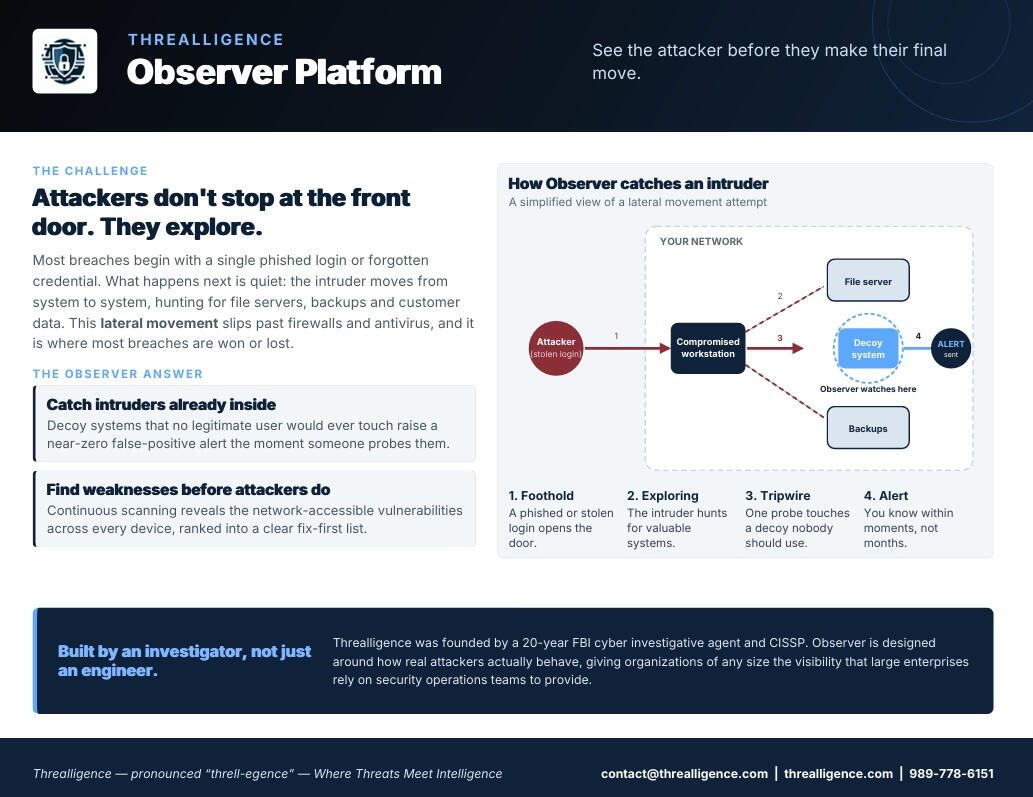
See the Attacker Before They Make Their Final MoveThe Problem: Prevention Alone Isn't EnoughEvery security budget goes toward keeping attackers out - firewalls, endpoint protection, email filtering. These are essential, but they share a common blind spot: none of them tell you what's happening after a determined attacker gets a foothold.Modern breaches rarely end where they begin. An attacker who compromises a single laptop, a forgotten VPN credential, or an unpatched printer doesn't stop there. They pause, get their bearings, and start looking around - quietly mapping your network to find what's actually valuable: your file servers, your domain controller, your backups, your customer data.This phase is called lateral movement, and it's where most attacks are won or lost.How Lateral Movement WorksOnce inside, threat actors behave less like burglars smashing a window and more like scouts casing a building from the inside. They:-Scan the network for live hosts, open ports, and exposed services
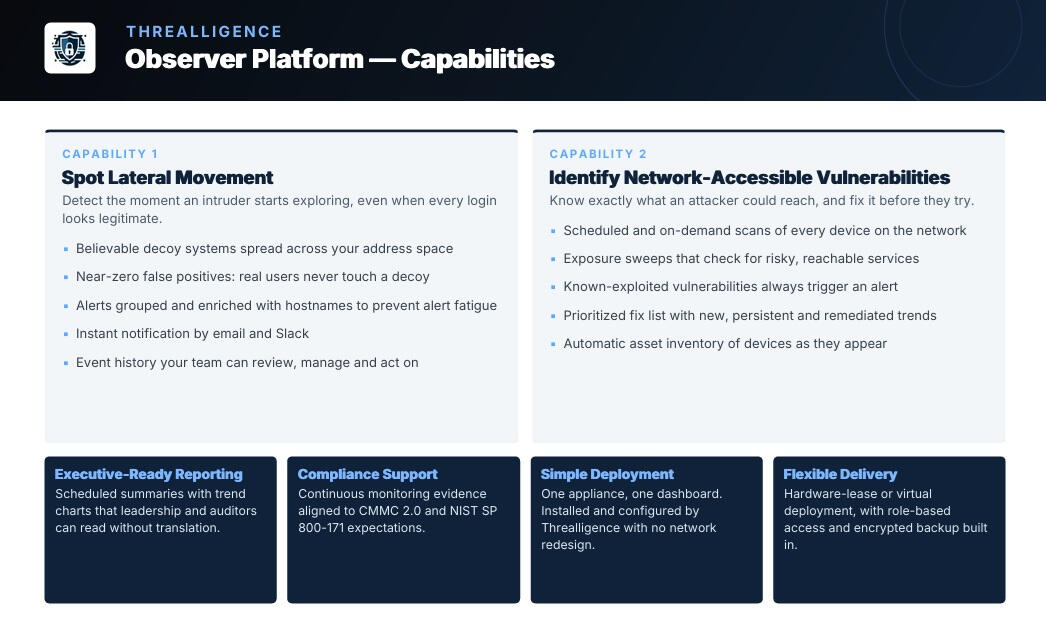
Enumerate systems to identify domain controllers, file shares, and admin workstations-Harvest credentials from memory, cached logins, and misconfigured accounts-Escalate privileges by hopping from low-value machines to high-value targets-Stage the final blow - ransomware deployment, data exfiltration, or destructive attacks - only after they know exactly where to strikeThis reconnaissance phase can take minutes or weeks. Critically, it's also the phase where most traditional security tools fall silent. Antivirus doesn't flag a port scan. A firewall doesn't stop traffic that "belongs" on the internal network. By the time damage appears, the attacker has already done their homework, and your systems have been compromised.For Small and Medium Businesses, this gap is especially dangerous. Enterprise security teams run 24/7 monitoring and dedicated threat-hunting programs. SMBs typically can't - not because the threat is smaller, but because the budget and headcount are.The Observer Platform: Detection Built for the Real World of SMB ITThe Threalligence Observer Platform closes this gap. It's a single security appliance that gives small and medium businesses enterprise-grade visibility into exactly the activity attackers depend on going unnoticed - without an enterprise price tag or a security operations team to run it.**Observer Platform combines two complementary capabilities in one deployment:Honeypot Detection - Catch Movement, Not Just MalwareThe Observer Platform deploys decoy systems and services directly on your network, convincing enough to draw the attention of anyone scanning or probing internally, but completely isolated from anything of real value.Legitimate users and business systems have no reason to ever touch these decoys. So when something does, it's a near-zero false-positive signal that someone or something is actively exploring your network.This means Observer Platform detects the reconnaissance phase itself - the scanning, probing, and enumeration that precedes an attack - instead of waiting for a signature match or a ransomware note. It's an early warning system that triggers on attacker behavior, not attacker tools, which is exactly why it catches threats that antivirus and firewalls miss.**Vulnerability Scanning - Know What to Fix, Before Someone Else Finds ItDetection tells you when someone is looking. The Observer Platform's integrated vulnerability scanner tells you what they'd find if they kept looking, before they get the chance.Running on a regular, automated schedule, the scanner inventories every system on your network and identifies:-Missing patches and outdated software versions-Misconfigurations that create unnecessary exposure-Known vulnerabilities (CVEs) affecting your specific systems-Services that shouldn't be exposed internally or externallyThe result is a clear, prioritized view of what needs patching, hardening, or retiring - giving network administrators a concrete action list instead of a vague sense of risk.Detection and Prevention, Working TogetherIndividually, honeypot detection and vulnerability scanning are each valuable. Together, they tighten the loop:The scanner tells you where you're exposed. The honeypot tells you when someone is exploiting that exposure. One reduces your attack surface; the other watches the attack surface you have left.For an SMB, this pairing delivers something that used to require a full security operations center: continuous, affordable visibility into both what's vulnerable on your network and who's actively trying to find out.Built for SMB RealityThe Observer Platform is designed around the constraints real small and medium businesses actually face:-Fast to deploy — a single appliance, not a sprawling security stack-Cost-effective — enterprise-grade detection without an enterprise budget or dedicated SOC staff-Low noise, high signal — honeypot-based detection produces alerts you can actually trust and act on-Actionable, not just informative — vulnerability findings map directly to what to patch, fix, or lock down next-Attackers count on small businesses lacking the visibility to catch them during the quiet, patient phase of an attack, the scanning and mapping that happens before the damage is done. Observer Platform takes that advantage away.Threalligence Observer Platform: detect the movement, know your vulnerabilities and close gaps before they become breaches.


Heurisko - Brand Protection and Attack Surface Management
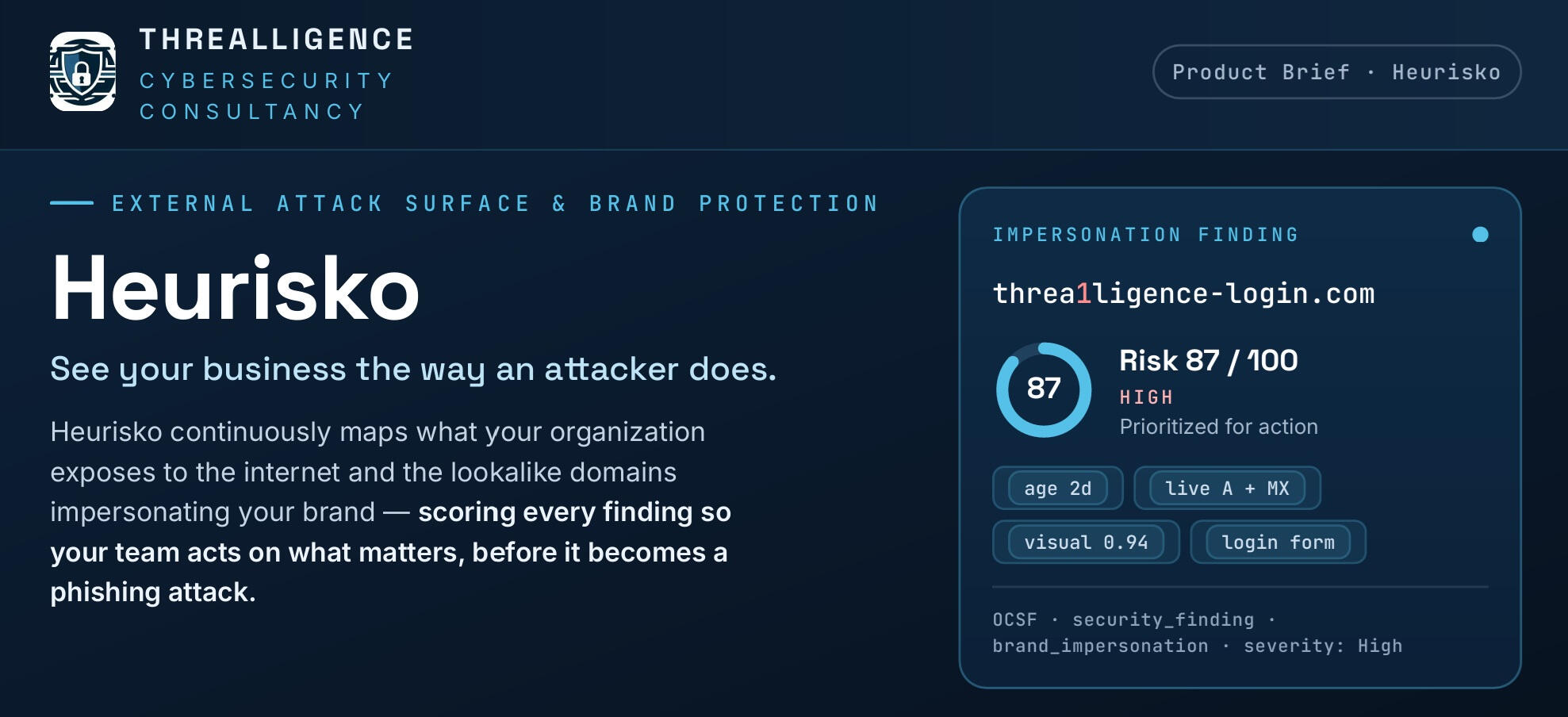
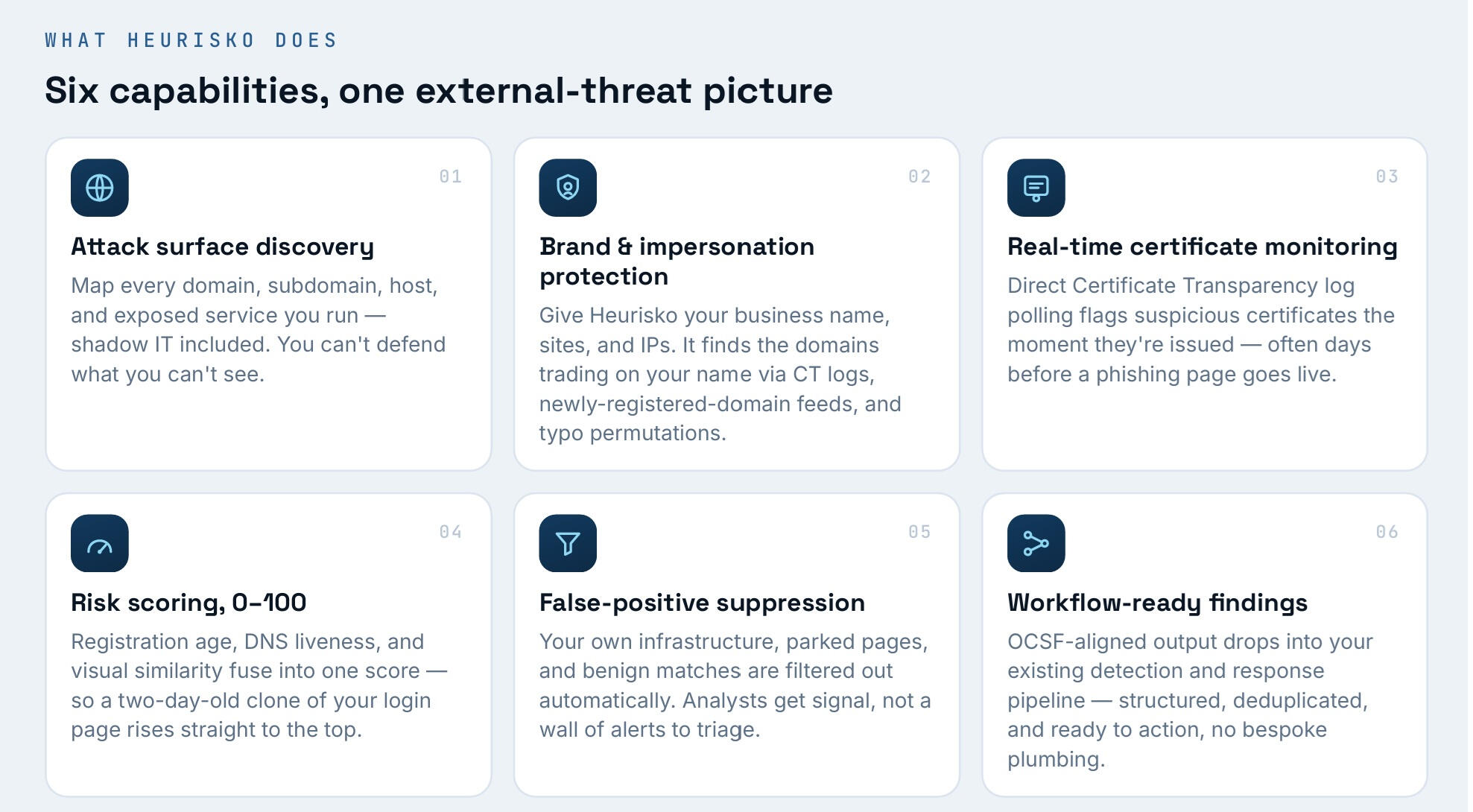
Heurisko, the Greek word for "find", continuously maps the assets you expose online, hunts down the domains impersonating your brand, and watches for your credentials in breach data - then hands you a short, prioritized list of what actually needs attention. Built and monitored by the security team at Threalligence.Heurisko is an external attack-surface and brand-protection platform from Threalligence. It looks at your organization the way an outside attacker would - cataloguing the domains, hosts, and services you expose, the lookalike domains set up to impersonate you, and the credentials of yours already circulating in breach dumps. Every finding is risk-scored and de-noised, so instead of a firehose of alerts you get a ranked shortlist your team - or ours - can act on.The problemAttackers start with reconnaissance. So should you.Most incidents begin with information that's already public: a forgotten server, an exposed admin panel, a convincing lookalike domain, a password leaked in someone else's breach. You can't defend what you can't see - and manually checking for all of it, continuously, isn't realistic for most teams. Heurisko does that watching for you, and tells you only when something matters.What Heurisko DoesExternal Attack Surface DiscoveryHeurisko maps what your organization exposes to the internet - domains, subdomains, hosts, and running services - including the shadow IT and forgotten infrastructure nobody remembers standing up. It checks for open ports and live services and enriches what it finds, giving you an accurate, current picture of your external footprint instead of a guess.Brand & Impersonation ProtectionRegistering a lookalike of your domain is usually the first move in a phishing or fraud campaign. Heurisko watches Certificate Transparency logs, newly-registered domain feeds, gTLD zone data, and typo- and homoglyph-permutations of your name to catch impersonation domains - often while the fake site is still being built.Breach & credential exposure monitoringHeurisko checks whether your organization's email addresses and credentials have surfaced in known data breaches, so you can force resets and close the door before leaked passwords get reused against you.Why it's differentRisk-scored, so you know what to do first. Every finding gets a 0–100 score from signals like how recently a domain was registered, whether it's live, and how closely it mimics your real site - so the two-day-old clone of your login page rises to the top and the noise sinks.Signal, not noise. Your own infrastructure, parked domains, and benign matches are filtered out automatically. You get findings worth acting on, not a wall of alerts to triage.Continuous, not a one-off. Heurisko runs on a schedule, not a single audit. New exposures and impersonation attempts surface as they appear, not months later.Backed by a security team. Heurisko is software and a team. Threalligence analysts review what it surfaces, so you get judgment alongside the data - not another dashboard to staff.How it works- Define your scope. You give us your domains, IP ranges, and brand names. That's your authorized monitoring boundary Heurisko stays inside it.
- Heurisko watches. Continuously, across your attack surface, the domain landscape, and breach data.
- Findings are scored and filtered. Ranked by risk, de-duplicated, with your own assets and benign matches removed.
-nYou act - with us. You get a prioritized shortlist and, when you want it, Threalligence analysts to help you respond.Why ThrealligenceHeurisko isn't a tool we hand you and walk away from. It's built and operated by Threalligence, a Michigan-based cybersecurity consultancy - which means you get enterprise-grade external monitoring without standing up your own security operations center. The platform does the watching; our team helps you make sense of what it finds and decide what to do about it. It's the kind of coverage that used to be out of reach for anyone but large enterprises.Capabilities at a Glance- External attack surface discovery - domains, subdomains, hosts, ports & services.
- Exposure enrichment for discovered assets.
- Brand & impersonation domain detection - Certificate Transparency logs, newly-registered-domain feeds, gTLD zone data, typo/homoglyph permutations.
- Near-real-time Certificate Transparency monitoring.
- Breach & credential-exposure monitoring.
- Risk scoring (0–100) with content and visual similarity analysis
- Automatic false-positive .suppression - own-asset allowlist, parked-page filtering.
- Scheduled, continuous monitoring.
- OCSF-aligned findings you can export or route into your existing tooling.


If you believe Threalligence software solutions are right for your business, or you have additional questions contact us any time by clicking here.Already have an account, Heurisko can be accessed at https://heurisko.threalligence.com* .